Bar Shrinkage: What It Is and Where It Really Goes
Shrinkage is the gap between what a bar pours and what a bar rings up. Every venue has some - the question is how much, and whether anyone can actually see it before it becomes a pattern. Ask five operators how big that gap typically runs and you'll get five different answers, because it depends on the drink mix, the till discipline, staff turnover, and how tightly the bar is run day to day. What's consistent across the industry isn't a number - it's the direction. Shrinkage rarely sits at zero, it compounds every shift, and it stays invisible until someone actually measures it.
Where it actually comes from
Overpouring
This is usually the biggest contributor, and it's rarely malicious. A jigger calls for a set measure, a bartender pours a bit heavier out of habit, generosity toward a regular, or just not watching the line closely during a rush. One extra splash per drink looks harmless. Multiplied across a busy shift, and then across a month, it adds up to real volume that never gets billed for.
Spills and breakage
A dropped bottle, a botched pour that gets tipped out, a cocktail remade because the guest didn't like it, the last measure poured down the drain at close. None of this is theft and none of it is really avoidable - but if it isn't logged as it happens, it looks identical to shrinkage from any other source once someone tries to reconcile the numbers.
Comps and freebies
A round on the house, a shift drink, "one for the road" for a friend of the bartender. Sometimes these get rung through the till as a comp with a manager's override; often they don't. Unlogged comps are functionally invisible until stock is physically counted and doesn't match sales.
Theft
The hardest of the four to prove and usually the one operators worry about most. A drink poured and never entered into the POS, a bottle that leaves with a delivery driver, stock quietly diverted over time. Without some form of continuous observation, there's rarely a way to distinguish a bad week of theft from a bad week of overpouring - both show up as the same missing volume.
Why the weekly count misses most of it
The traditional way to catch shrinkage is a physical stocktake: weigh or eyeball what's left on the shelf, compare it to what the POS says was sold, and treat the difference as loss. It works, but it's a snapshot, not a measurement. A problem that starts on a Tuesday isn't caught until the following count - by which point a week's worth of the same habit or the same person has already repeated it. And because the count only produces one number, it can't tell you whether the gap that week was mostly overpouring, mostly spillage, or something else entirely.
What changes with a camera on the shelf
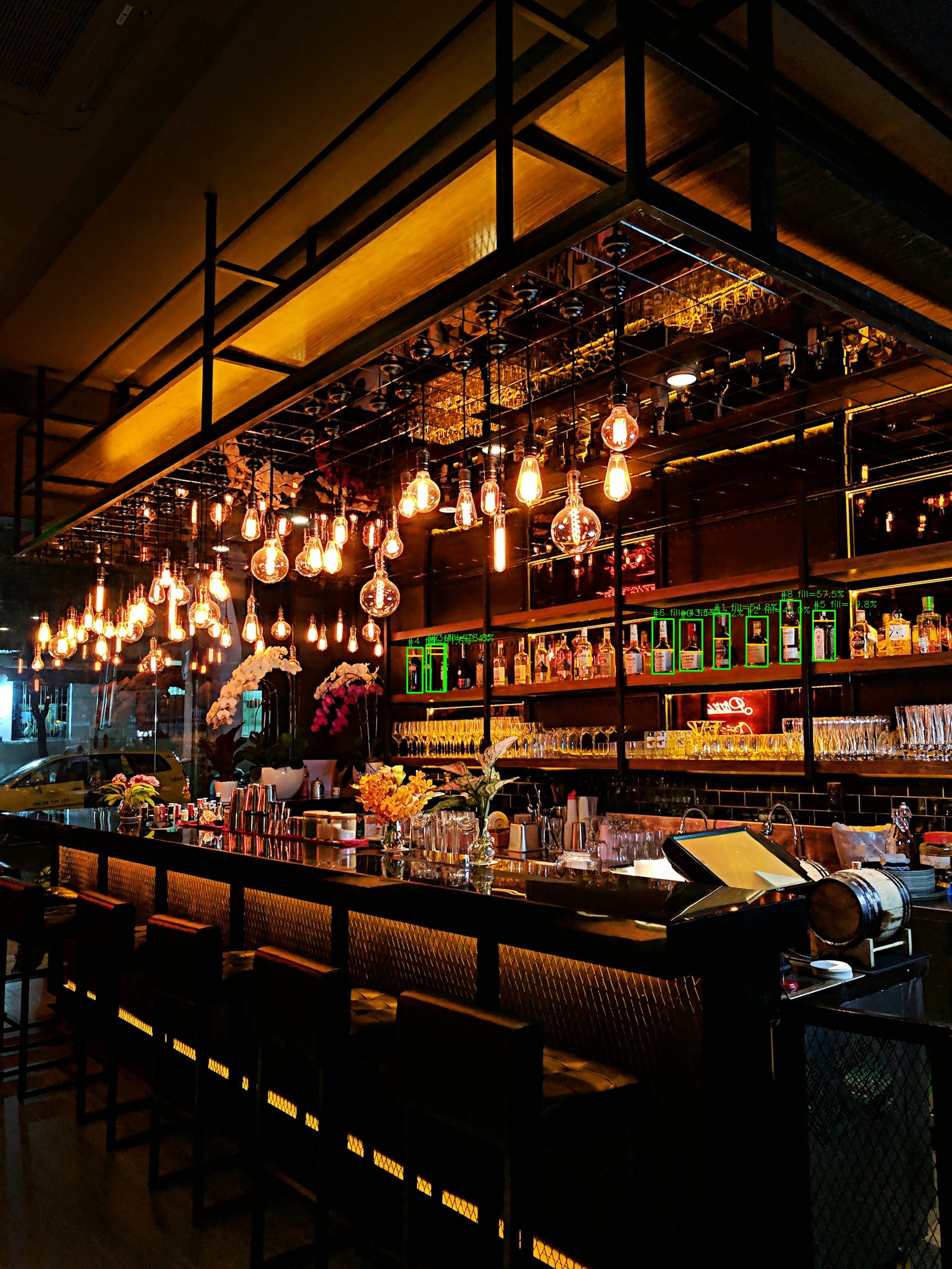
A camera-based system does the same comparison a manual stocktake does - pours against sales - but continuously instead of once a week. Two cameras positioned above the back bar track bottle count and liquid level throughout service, and that read is cross-checked against point-of-sale data as it comes in rather than after the fact. When the two don't line up, it shows up as a variance the same day, not the following weekend.
That continuity also helps separate the four causes above instead of lumping them together. A spill or a remade drink can be logged as it happens and excluded from the picture; a pattern of variance tied to a specific shift or product is a different signal than a single random gap. It doesn't make shrinkage disappear on its own - it turns a once-a-week guess into a daily read, which is what actually lets an operator tell overpouring from theft and act on the right one. For the practical differences between that daily read and a manual count, see our piece on manual vs. Camera bar inventory. If a camera near the bar raises questions for your team, we cover the practical side in GDPR and cameras in bars.
See what a camera catches on your shelf
We run a 90-day pilot with no charge and no obligation to continue.
Request a demo